

AI in Debt Collection – Automation and Support
AI in debt collection is not just about advanced models, but practical improvements to everyday work. Next-best-action assistants, automated document analysis, intelligent customer communication and portfolio management support can help teams work faster and make better-informed decisions. Mirosław Wnuk explores where artificial intelligence is already delivering real value in debt collection processes.

The Discovery phase in IT projects for insurance companies – why is it worth starting with this phase?
A major insurance IT project may already have a budget, timeline and list of requirements, yet still rely on assumptions that have never been fully validated. The Discovery phase helps verify solution consistency, technical feasibility and business rationale before development begins. See how Discovery reduces the risk of costly scope changes and creates a stronger foundation for successful project delivery.

Low-Code in a Cooperative Bank: How Small Steps Can Streamline Everyday Operational Processes
Cooperative banks face many of the same regulatory requirements as large commercial banks, but with significantly fewer IT resources. Low-code makes it possible to digitize specific processes without replacing core banking systems or launching large IT projects. We explore three practical use cases: branch reporting, loan agreement monitoring and functional controls.
AI Agents in Debt Collection: Turning Data into Smarter Decisions
Modern debt collection requires more than predefined workflows and fixed rules. An AI Agent analyzes historical data, customer behavior, and case history to recommend the next best action at every stage of the collection process. Discover how AI empowers collection teams, improves recovery rates, and enables faster, data-driven decisions while keeping people in control.

73% of insurance CEOs expect growth. Why do only 25% of initiatives fully succeed?
Most insurers have a clear transformation strategy, but far fewer succeed in turning it into measurable business results. What sets market leaders apart? Discover the four operational capabilities that enable insurers to accelerate product changes, automate key processes, and respond to customer and market demands with greater speed and agility.

Green Loans Can Move Faster. What Is Slowing Down Credit Decisions Today?
Green loans are becoming a standard part of banks' and lenders' product portfolios, yet many institutions still struggle to scale their adoption. The challenge lies not in customer demand or product design, but in complex credit processes and lengthy decision times. Discover how process simplification, automation, and smarter ESG integration can transform green lending into a scalable, profitable financial product.

Technological Trends and Challenges in Debt Collection
Automation, digital court processes, and advances in artificial intelligence are already reshaping how financial institutions manage collections. This article outlines the current state of that transformation, the direction it is likely to take, and the criteria for selecting the right technologies.

ESG in Credit Assessment: Why Banks Must Calculate It, Not Just Report It
ESG in banks currently functions primarily as a reporting and regulatory area. However, it is becoming increasingly clear that this approach is insufficient. Environmental and transition factors have a direct impact on clients’ financial standing and, consequently, on credit risk. This means ESG is no longer a side topic—it is becoming an integral part of creditworthiness assessment and portfolio quality assessment.

Discovery Phase in Banking. How to Reduce Risk in IT Projects
Just a few years ago, artificial intelligence in the insurance industry was little more than a curiosity featured in conference presentations. Today, it is one of the most frequently discussed topics in requests for proposals and business development discussions.

Low-code as a platform for building process applications – from models and algorithms to user interfaces
Banks today operate in an environment of constant change—technological, regulatory, and business-related. They introduce new products, respond to competitors’ moves, and meet growing customer expectations regarding innovation and service speed. As a result, IT systems must be continuously developed.

Why the most successful IT implementations are built on partnership
In the face of the growing complexity of IT system implementations, as well as increasing regulatory pressure and security requirements, something more than technology itself is becoming crucial. The success of a project is increasingly determined by the collaboration model, the vendor’s real accountability, and a partnership-based approach to the client. This foundation ultimately decides whether a system becomes genuine support for the business or remains merely an expensive tool. Mirosław Wnuk, Director of Development for the Debt Collection Area at VSoft, talks about what cooperation with clients looks like in practice.

How Digitization and AI Are Transforming Receivables Management
The ongoing digitization of the judiciary, the new version of the Electronic Writ-of-Payment Procedure (EPU), and AI-based tools represent the biggest shift in the debt collection industry in years. Mirosław Wnuk, Head of Debt Collection Development at VSoft SA, discusses the planned implementations and their impact on institutions managing receivables.

Effective Monitoring of Corporate Clients — Why It’s Worth Investing in This Area
Many financial institutions still assess corporate credit risk in a point-in-time manner: during loan applications, selected operational activities, and periodic reviews. Today, that’s no longer enough. The economy moves faster than reporting cycles, and a single external shock can trigger a domino effect. Banks need to know what is happening with a client right now — not only when delays finally appear.
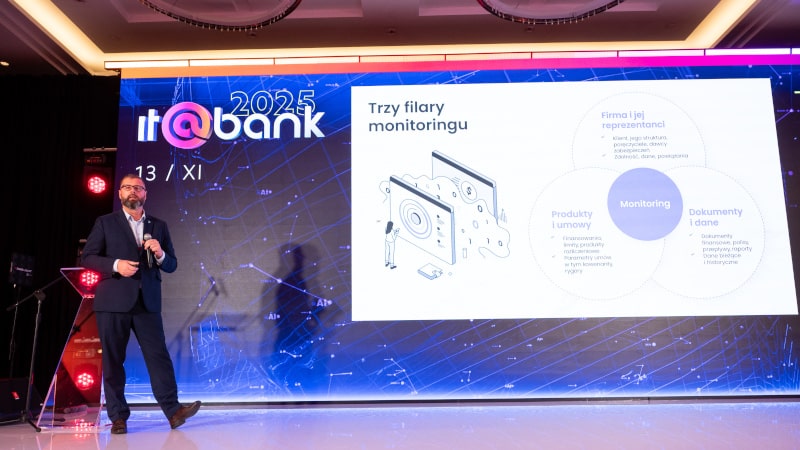
How Do We Build an Effective Corporate Client Monitoring Process? – A Summary of Our Presentation at IT@Bank 2025
On 13 November, we had the pleasure of partnering with the IT@Bank conference, where we shared our perspective on building an effective process for monitoring corporate clients. Our speaker, Jakub Rabong, walked the audience through what the post-sales journey looks like in practice, and what challenges banks face when data originating from a single agreement begins to live simultaneously across multiple systems.

When Risk Monitoring Loses Its Effectiveness – and How Banks Can Respond
In many financial institutions, corporate client monitoring still operates as a set of isolated actions rather than a continuous, integrated process. Data is scattered across multiple systems, credit ratings are updated with delays, and critical risk information does not always reach the right teams in time.

Modern Risk Management in Banking: Early Warning and Rating Systems
How can banks support their clients’ growth by financing their investments while simultaneously protecting themselves from the risk of financial loss? In banking, credit risk management is a top priority. Two key tools that help achieve this are the rating system and the Early Warning System (EWS). Each of them is effective on its own, but it is their combination that creates a powerful duo capable of protecting a loan portfolio from significant losses.